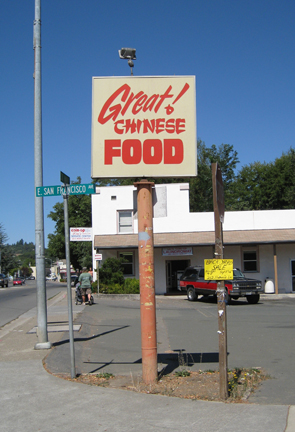
I’ve been so distracted—by various foods, effin Republicans, & little sewing projects—that I almost forgot to mention the Road Trip show at San Jose Museum of Art, on view now through 25 January 09. I’m tickled & humbled to have my Chinese restaurants included alongside some really great artists’ work. If you’re a museum member, maybe I’ll see you at the reception later in October.
schmindigo
cruciferous
I dunno bout you, but I just don’t believe in the whole meal-planning concept where you set off to the grocery store to buy a half cup of peas, 3 medium-size bananas, 2 white onions & whatever else will fit exactly into the recipes you have painstakingly plotted out for exactly a week’s worth of meals. What about inspiration? What about improvisation? What about cooking according to what the produce gods & goddesses (I mean, the farmers) send you this week?
Broccoli, for instance, is something you can always get, pretty much anywhere in America, & for that I am eternally grateful (especially when I’m in Wyoming). But really exceptional organic broccoli—gorgeously green, so fresh it seems immortal, & bug-free—is a precious gift that only comes once in a while. I think it’s the bug-free part that makes it so rare. I don’t know why it’s so hard to grow unbuggy organic broc, but when the broccoli stars align, I pounce.
Here is Cruciferous Pasta, for just such an occasion, when you have broccoli to make you sing, & equally good, snowy, downy cauliflower.
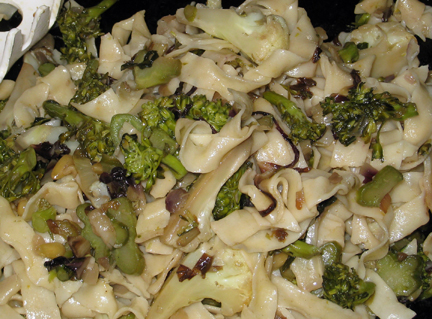
(Sorry bout the unglamorous picture. I was hungry! That’s the edge of my pasta claw up there in the corner. The thing gets so much use, I should probably trade up for one that’s not plastic.)
a few young broccoli crowns
small to medium size head of cauliflower
very large shallot (or 3-4 small ones), chopped
small yellow onion, chopped
handful capers, chopped
handful pine nuts
small head of treviso, sliced crosswise into approx. half-inch strips
lots o’ olive oil & a little bit o’ butter
garnish: small dry-farmed early girl tomatoes, quartered & sliced, 1 per serving
lemon fettucine
Put the pasta water on to boil. Cut the broccoli crosswise (quarter-inch or thinner slices), starting at the bottom of the stalk & continuing up until the florets separate & fall into a heap. Break the cauliflower apart into trees or lollipops (pick your metaphor), then cut them into spears unless they are already fairly slim.
Heat olive oil & butter in a large pan, & add ingredients in the following order: onion & shallot, (pause), broccoli, (pause), cauliflower, (long pause), capers & treviso, (pause), pine nuts.
My pauses usually accommodate chopping the next ingredient, & I’m a fairly slow chopper. YMMV. All the while you are adding olive oil in generous amounts as needed & turning things so they cook evenly, like a very slow stirfry. Cook a good while, until treviso is dark, limp & nearly unrecognizable, broccoli begins to fall apart a bit, cauliflower turns translucent & shows browning on some of its flat surfaces, & the whole thing takes on a certain cohesive quality, having passed the stage of each ingredient remaining independent & discrete. At a late stage of this game you’ll drop your fresh pasta in the boiling water.
When pasta & stuff are both ready, add the pasta to the pan & mix it all together. Serve with tomatoes on top, & microplaned pecorino &/or toasted breadcrumbs.
But don’t go putting “broccoli” on your shopping list & thinking it means you’ll get this!
seduced by September...

I think I smell an apple pie in my near future. Could be as soon as next week.
Great!
One of these things is not like the others, but sometimes I just gotta brag about my fabulous bro—how I love this little skirt!

Now back to our regular programming.
Blackberry nectarine plum pie, made with wild blackberries from the Eel River…

...& piecrust cookies, because I always have leftover pie dough (but of course, never enough to make a whole nother pie).

Spotted in Willits en route to the river:
salad dressing manifesto
When is it a good idea to overdress your salad?
Answer: almost never. (If you want to skip the rant & cut to the exception, scroll down to the last paragraph.) Friends know that my already-opinionated tendencies get cranked up to 11 when it comes to the topic of dressing salad. To me, excess salad dressing speaks of an underlying contempt for the vegetables in the salad… & for all vegetables as a class. I’m not saying that every individual saladmaker who overdresses his salad holds vegetables in contempt; ignorance, inexperience or lack of attention are probably more often the true culprits. But even the most hapless newbie cook guessing wildly at how to dress a salad for the first time bases her guess on something, & this is where pernicious cultural tendencies come in to play.
I think we can agree that there is a strong meat & potatoes streak running through this country we call America, & many an American has been heard saying that they’d really rather not eat any veggies at all if they could help it. If they must, well, it’s better if they’re as un-veggie-like as possible: remember ketchup? (Okay, perhaps not the fairest example.) Add fat! Add protein! Add anything to mask, to distract from, to overwhelm the veggie nature of the veggies! How many times out there on the road have I ordered “salad” & ended up with a woeful handful of iceberg crushed under the weight of almost-solid dollops of thick dressing?
Arg!
A good salad should be all about the vegetables. If you don’t like greens, go eat them fried in bacon fat or something; veggies shrink when they’re cooked, so you can get more of those annoyingly necessary vitamins in fewer bites. Also, a veggie that is not quite fresh enough to become (good) salad may often be very acceptable for (good) cooking; so then you should go ahead & cook the dang thing! (Don’t come crying to me that lettuce can’t be cooked. I’m Chinese.) All of this being the case, then, isn’t salad nothing more or less than a perfect opportunity to eat many, many wonderful mouthfuls of fresh raw veggies, thus prolonging & indulging the ecstatic enjoyment of same?

If so, why would you drown this good stuff in too much dressing? In a perfectly-dressed salad, the dressing should merely lubricate the lettuce. Visually it should appear not so much as a salad ingredient itself, but mainly as a shine on the surfaces of all the other ingredients. When you put lotion on your hands, do you leave drops & clumps of white opaque stuff visible all over your skin? I hope not. Use a small enough amount of dressing so that it barely films the leaves.
In order to accomplish this, you must be willing to toss your salad. I cannot emphasize this enough. Use a large bowl so that you have room to turn your salad over without dropping half of it outside the bowl. Put all your lettuce & stuff in this large bowl, then take a wee tiny bit of dressing & pour it over the top. It will look like it can’t possibly be enough. Have faith! Start lifting up big batches of salad from the sides of the bowl, dropping them in the middle. Pull salad from the bottom & put it on top. Move more-dressed stuff into contact with undressed stuff. The more lightly you want to dress your salad, the more tossing you have to do. It will be worth it. When the dressing is no longer discernable as a separate thing, & all parts of the salad are subtly glistening, you’re done.
Eat your salad!
If you get to the bottom of the salad bowl & there is a puddle of dressing there, you used too much dressing.
Except. There is always an exception, right?
Except when it’s high tomato season & there are dry-farmed Early Girls from Dirty Girl. Then, then you make yourself a salad that is mostly tomatoes (hold each tomato over the bowl as you cut it into chunks, so as to catch every drop of juice), a little bit o’ lettuce, a little bit o’ basil, & you pour on just a little too much dressing (olive oil, balsamic, salt & pepper). Why? Because as you eat your salad, the tomatoes will juice themselves all into the bottom of the bowl, & when you get down there, you will find the most divine puddle of tomato juice, seasoned with that bit of extra dressing, & you can plop a piece of sourdough toast in it & go swooning off to heaven. That’s why.

sage roasted chicken
Hey, it’s summer for another couple of months, but foggy evenings do lend themselves to roast chicken. I have been working on this recipe for a couple of weeks now, sort of blundering around in an experimental mode, & when it finally hit the mark, I realized that I was applying salad-making principles to roast chicken! No wonder it worked. If there’s one thing in the world I’m confident of, it’s my salad-making principles.
Key salad concepts as applied to sage roasted chicken:
1) Seasonal flexibility: you have your main ingredients that define the recipe—in this case, chicken legs, sage leaves, olive oil, shallots, & tiny taters—& then infinitely swappable supporting ingredients, depending on what comes home from the farmers market. I have used various kinds of summer squash, radishes (the little skinny long ones that are half pink & half white), treviso, carrots, flat-leaf parsley, & now am thinking about adding some kind of fruit. Perhaps figs.
2) One-dish meal: no need for pesky, distracting side dishes to round out your nutritional needs. There’s plenty of veggies in the pan. You can steam some brown rice to go with this (it soaks up the sauce deliciously), but the taters provide more than enough starch if you’re feeling extra-lazy (or extra-purist).
3) Good ingredients tossed in good dressing. If you get quality ingredients, your dressing is sound & your tossing thorough, you will have a good meal. No muss, no fuss.
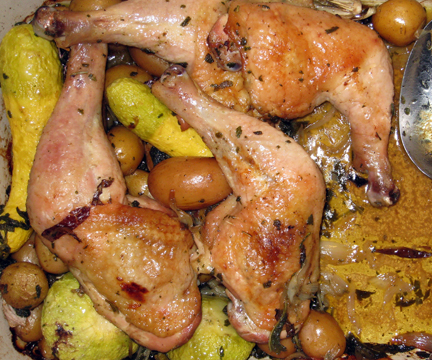
So. The blow-by-blow for Sage Roasted Chicken:
Main ingredients:
6 chicken legs (here too, you can substitute your preferred chicken part, or a whole bird), rinsed & patted dry
Bunch of sage leaves (don’t be shy! Use a whole bunch!)
Tiny taters, no bigger than an inch. Most recently I used a mixture of German Butterballs & 2 different kinds of fingerlings.
Shallots, the more the better, but at the very least 2 large ones. Peel & cut in 2 or 3 pieces lengthwise.
Olive oil, butter, salt & pepper
Rotating cast of other ingredients:
Small summer squashes, preferably tiny sized, but if you get bigger ones you can halve or quarter them.
Radishes
Treviso, quartered lengthwise
Small carrots
Any other veggie that roasts well
Any other herbs that play well with sage
Method:
Preheat oven to 400 degrees.
Warm a generous quantity of olive oil in a pan on the stove. Melt some butter in it too, & fry up the sage leaves. Don’t crowd the leaves too much; you can do them in batches if your pan is small. As the leaves get done, transfer them to your baking pan.
Add all your washed & cut veggies & chicken to the baking dish. Pour the sagey oil & butter all over everything, add salt & pepper, & toss like a salad! When everything is nicely coated, arrange things so the veggies form a single layer (it can be a crowded, jumbled single layer) on the bottom, & put the chicken on top. Take care to cover treviso & any cut sides of squash with the chicken.
Stick it in the oven. Then, every 15 minutes, take the dish out & turn the veggies &/or spoon the pan juices over the top. Pay attention to how the chicken is progressing; at one of these turnings, you will note that another 15 minutes would be too much. Then adjust your timer accordingly—or turn up the sensitivity on your Chicken Sense (equal parts smell & intuition, I think) & just know when it’s done.
There you have it. Very much like a salad. This recipe just adds a lot of heat, that’s all.
egg renaissance
Seems to be the Summer of the Clafoutis. I’ve been having quite a love affair with all eggy things, now that the Riverdog pastured eggs have transformed my entire egg reality. It’s an egg renaissance around here for sure.
Here, then, is fig clafoutis, prompted by my mother’s food-oriented (of course: I ask food questions, she gives me food answers) report on her trip to Provence.
Using a very well-seasoned cast iron pan, you follow procedure for my easy fig thing, except instead of taking the figs out of the pan, you flip em over so the inside, cut half is facing up. Then drizzle honey all over, making sure a lot of the honey ends up on the bottom of the pan. I wasn’t measuring but I guess it was about 1/4 cup of honey. Pour your batter over, then slide the whole thing into the oven. For the batter, I pretty much followed Orangette’s recipe, except instead of sugar, I squirted a bit (hm, maybe a tablespoon) of agave syrup into the batter, & figured the honey would take care of the rest.
It did. Yum!

& just because I haven’t posted a salad in a while, don’t you think I haven’t been eating any…
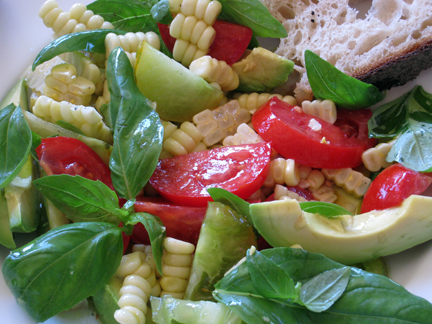
Does August not rock harder than any other month? Go on & try to convince me there’s a sweeter time of year.
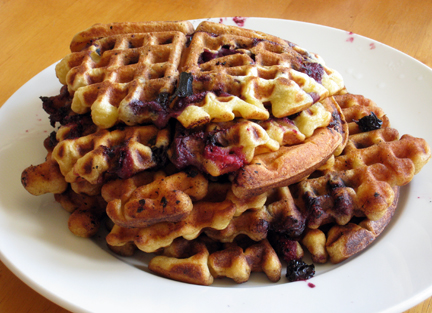
let them happen
A couple weeks ago I scrawled on kitchen scrap paper this little list of things to make & eat! It floated along the kitchen currents from chair to floor to counter, & every once in a while I’d catch it & check things off. I’m happy to say I’ve done everything on the list. Some of em I did more than once! This kind of to-do list is great for summertime food, & also this approach to it: first dream some simple dreams… & then just kinda let them happen. July is not the time to get all uptight & structured about getting things done.
corn with cilantro & lime: on or off the cob, yellow or white, with olive oil or butter… I buy my corn from Avalos whenever possible, or Catalan. (Not to get all essentialist, but there’s something so satisfying about the fact that Chicano-owned farms are growing the best organic corn. I feel downright smug on their behalf.)
stonefruit clafoutis: I already showed you a photo of this one. No specific recipe. You break some eggs, whisk in some milk & flour, a bit of agave syrup.
BLT: need I say more?
melon & prosciutto: a classic, of course, but I tend to forget about it for years at a time, probably because I was vegetarian for so long.
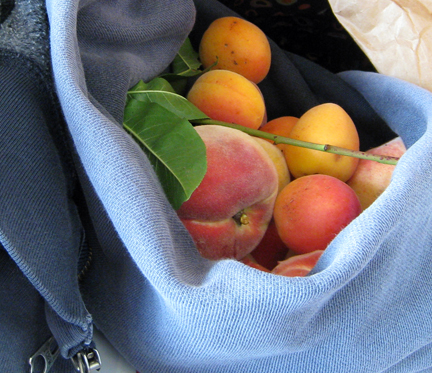
white peach ice cream: this was originally gonna be lychee ice cream, but then Cooking Show & I were walking by Mr. PVC’s garden eden & spied his little peach tree heavy with fruit; the irrigation guy who was there said he’d been instructed to “eat as many peaches as possible” & invited us to help. Well twist my arm! I loaded up the hood of my sweatshirt, topped it off with a few apricots, & then had to do something with them pretty much right away because they were that ripe.
blackberry pie: this has become somewhat of a birthday week ritual for me. All seems right with the world when you’re making a blackberry pie.
pesto: the first of many batches!
Japan
Here are the Japan food photos I promised!
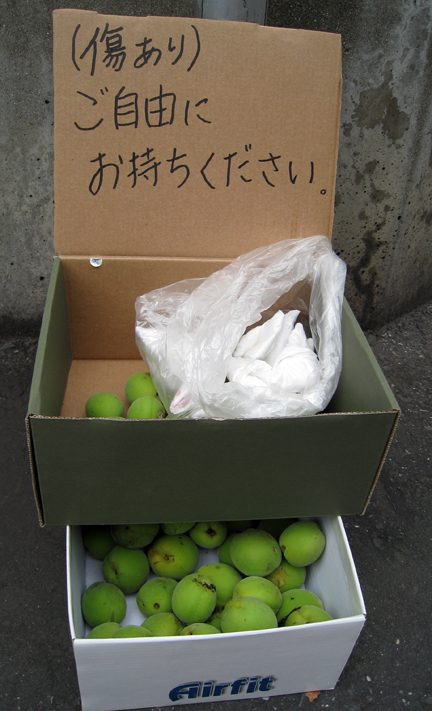
It was ume season & we saw this little ume giveaway on the street. Note the perfectly knotted plastic bags so thoughtfully provided:
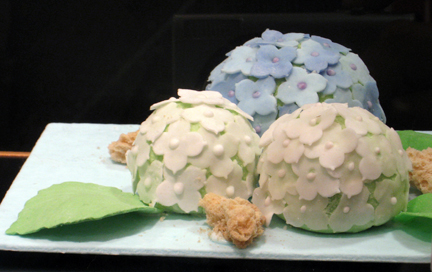
It was also hydrangea season. Cherry blossoms get all the press, but I thought the hydrangea enthusiasm was pretty dang intense too:
More pretty sweets:
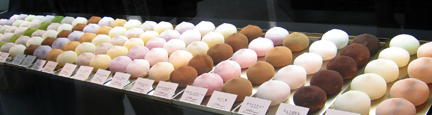
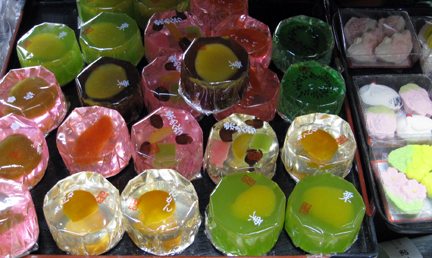
King of Nosh took us to a cute French-Italian place that was tucked away on a quiet lane in Shibuya. When it was time for dessert they brought us this adorable little corkboard:

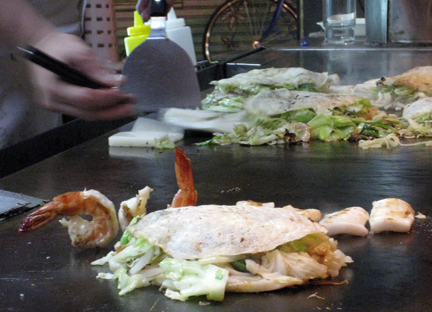
He also showed me a very good okonomiyaki time in Shimokitazawa. I don’t understand why okonomiyaki isn’t everywhere, all over the world, especially in breakfast places in the USA. Pancakes, homefries, eggs, okonomiyaki… why not?
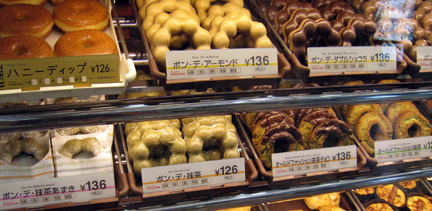
Four variations on the matcha donut theme:
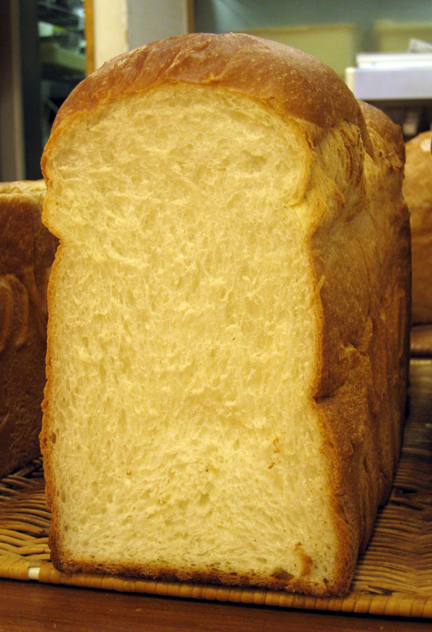
They like their bread tall:
I always thought I didn’t like eggplant, but apparently when you slather it with miso & grill (broil?) it to perfection, I fuckin love it.

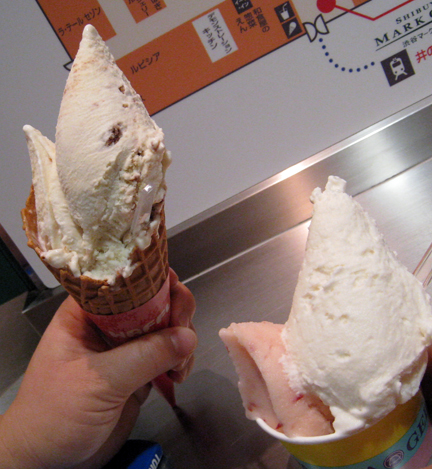
I also fuckin love ice cream, but that’s not exactly news. Gelato from the very-mobbed Pariya in the Foodshow basement of Tokyu Dept. Store, also in Shibuya: lychee, plum, jasmine chocolate cake(!), & coconut banana maple. Then we went back & had green tea tiramisu, apricot, & cherry.
Heather Johnson
Heather Johnson is up to another one of her excellent projects. You can participate if you’ve ever been to New York City. Actually, at this point, I’d be pretty interested in meeting someone who has never been there.
blackberry knowledge
Japan photos must wait, because we are awash—no, drowning—in fruit. All manner of stone fruit, strawberries, melons, lychees… & now the backyard contributes blackberries! I grew up picking blackberries every summer & have accumulated quite the Blackberry Knowledge, which I shall now share with you. Yes, there are actually some tricks.
Respect the thorns, & know yourself. You have to get into a careful & graceful state of mind to pick blackberries. No sudden moves, no jerking around, no careless shoving branches aside in order to reach your berries. If you would rather not be patient & slow & exacting, then by all means wear thick, tough clothes (like heavy denim) that cover as much skin as possible, & boots on your feet. On the other hand, it’s possible to pick blackberries in nothing more than a flimsy sundress & flipflops, as I did today. It has to do with personality, mood, & experience. In any case, however, you should not wear gloves; more about that in a minute.
Get down low & look up to spot the berries. Try it; you’ll be amazed at how many berries are hiding underneath all those leaves!
Most common blackberry-picking mistake: picking them too soon. A sure way to end up with a lot of mouth-puckering, super-sour berries! No! Arg! Second most common mistake: picking old berries. Here are the clues:
You want berries that are 100% black, no red anywhere, not even dark reddish purple.
Look at the texture of the berry. Perfectly ripe blackberries almost literally glow; they are glossy & shiny, & each individual globule of the berry is fat & round because they are all full of juicy goodness. Past their peak, those same berries will be dull, flat black, &/or the little globules will start to shrivel & wrinkle. (Often at that point they will have invisible but horrible-tasting mold, too.) The color & shine of ripe blackberries is what calls me from all the way across the yard & inside the kitchen: “come pick us right now!”
Helpful illustration: the red part circled on the left indicates a berry picked too soon. The shriveling part on the right indicates a berry past its prime.

Now here is the most important part, & why you can’t wear gloves to pick blackberries: you need the sensitivity of your fingertips to feel the amount of resistance when you try to pull the berry from the stem. It should just about fall into your hand at a touch. I usually nudge the berry to one side to see if it will come off, rather than pulling straight away from the stem. If you have to put any effort into pulling—& I do mean any—then the berry is not ripe enough. Think of picking a small object up off a table, not detaching two attached objects; a blackberry should feel like you’re just moving it from where it sits on the stem.
Also, a ripe berry is not hard; with practice you can tell by touch whether it is the right degree of tenderness. With this delicate touch you will also avoid bruising the berries—useful if you’re doing anything with them besides popping them directly in your mouth.
All this fine-tuned awareness, dancing between thorns with your fingers, & the willingness to let go of each berry if it won’t yield immediately to your touch, is what makes blackberry picking a very meditative experience. There are other methods, but I find this the most satisfying.
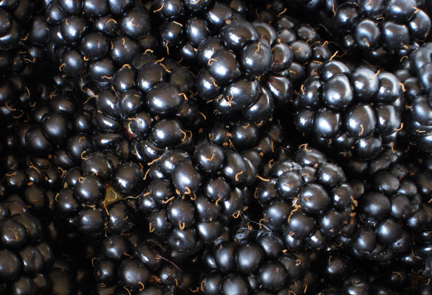
Here is what you want your bowl of blackberries to look like: midnight with stars. Every little nodule should be plump & glossy, each berry tender, the whole bowl fragrant with blackberry perfume—the essence of summer.
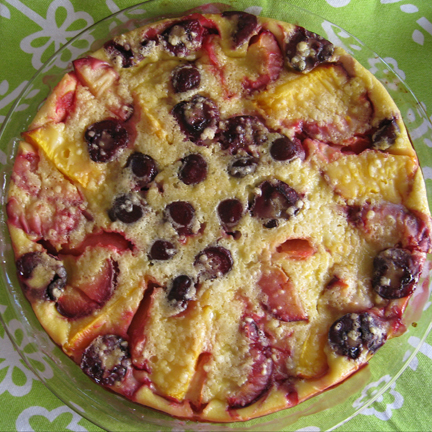
(In case you’re curious, that’s a stone fruit clafoutis in the picture at the top. No blackberries in it.)
grace
Japan is a country of many graces: grace in manners, grace in design, grace in seasonality, to name just a few. So could it perhaps be a form of rebellion that the young women of Tokyo (well, not all, but a critical mass of them) render themselves so completely graceless by choosing the most ill-fitting footwear possible? Never have I seen so many women stumbling, shambling, hobbling, shuffling, limping & clomping in deliberately-oversized, too-high, beyond-uncomfortable shoes. They simply cannot walk. They are clearly in pain. To my outsider’s eye, they look utterly ridiculous. Obviously there is some cultural value operating there that is beyond my ability to grasp.
Back home now, on my habitual walk to neighborhood post office & bank, I felt a great sense of relief at seeing women of all ages, sizes & shapes walking gracefully, comfortably, in a huge variety of shoes—including some that would render me personally quite ungraceful, but the women wearing them had learned to walk in them gracefully, or at least effectively. As an American woman, I always understood “learning to walk in high heels” as a prerequisite for wearing same. (Which explains why I never wear them.) I remember a friend describing a pair of stilettos as “shoes you only wear from the limo to the bed” (not something I would ever put on my feet!) but she must have made sure she could walk at least that far in them without looking like she was going to fall on her face any second.
Not so in Tokyo. My cousin Travelin’ Fool goes to Japan quite a lot, so I turned to him for an explanation of these self-imposed gait problems. He said that it actually is considered sexy there. We began to speculate why: the Helpless Female taken to an absurd extreme? You look more like a little girl if your shoes are a whole size too big? Ew. Maybe it’s enough for me to feel grateful that I live in Berkeley, the Comfortable Shoe Capital of the nation, if not the entire world.
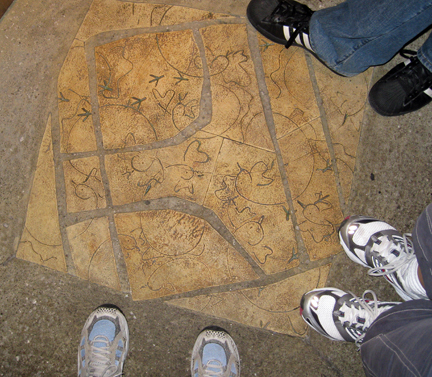
Here we are in comfy Berkeley shoes, admiring the cute chicken-motif floor tile at a yummy chicken restaurant (chicken cartilage on a stick! deep fried chicken skin! zow!) with our personal curator of Tokyo eats, the King of Nosh.
Now isn’t it just like me to come back from the most fabulous trip & start off by ranting & complaining about something? I once heard of a Norwegian motto that translated “Away good, home best.” That’s definitely me, & that’s what you’re hearing now, but never fear, the next post will be a rave.
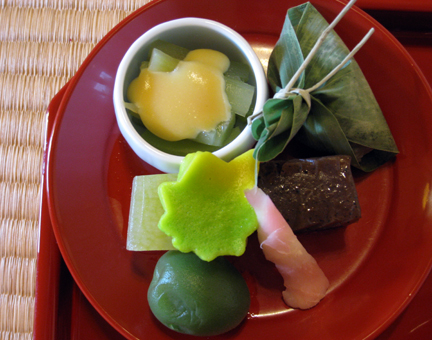
Guess where I went? More later when I get over the jetlag….
lavender


Honolulu
That One Way or Another show keeps going & going… next stop, Honolulu Academy of Arts, opening on the 18th. Tell your friends in Hawaii!
I’ll be at the members’ reception on the 25th, so if you’re a HAA member, come say hi.
tender
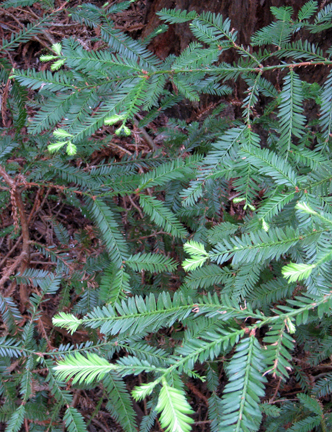
This week’s suggestion: go out & fondle (gently!) some tender baby tips of redwoods. See those light green parts? They’re much softer than the older dark green.
chill
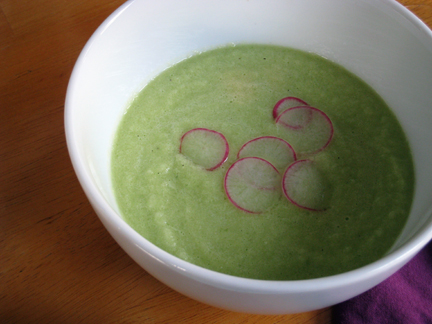
Cucumber gazpacho, garnished with mandolined pink radish. Adapted (slightly) from César cookbook.
8 cups English cukes, peeled, seeded & coarsely chopped
1-1/4 cup good olive oil
1 cup ice water
1 clove garlic
1/4 cup white wine vinegar
2 T. Meyer lemon juice
2 t. salt
1/4 t. pepper
optional: cayenne to taste
Blender half of it at a time, tasting & adjusting proportions. Then chill.
Other garnish possibilities: drizzle of olive oil, drizzle of pesto diluted with olive oil, fresh basil leaves, fresh mint leaves, thin ribbons of nasturtium, bits of chive flower, &c. &c. The beauty of this soup is that it’s so easy to make, so easy to dress up, & unusual enough to charm your dinner guests. Talk about chill.

oatmeal & other good stuff
Once upon a time, I was invited to a posh art colony, where I learned many things about my artmaking process, about the New York art scene, & about oatmeal. The process stuff was very important (& still is), & the art scene stuff was informative, but the oatmeal was a fucking revelation.
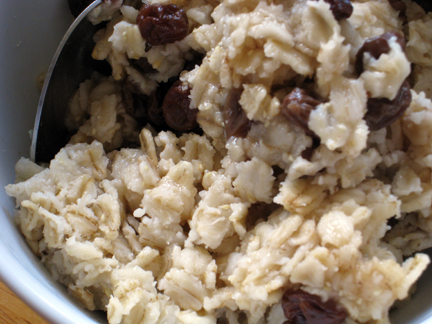
I thought that I didn’t like oatmeal. It was always too gooey & gloppy & reminded me too much of, I dunno… like, barf. Or something. To think that I nearly missed this oatmeal just because I was in the habit of sleeping through the breakfast service! The dinners were always very good though, so one fine morning I made a point of waking up in time to check out breakfast.
I don’t remember what else there was, but the oatmeal was unlike any I had ever seen before. Each individual oat was fluffy & plump & discrete from every other oat. They clumped together like grains of rice or couscous instead of being glued together in a viscous gummy mush. Intrigued, I plopped a small spoonful in my bowl, melted some butter on top, & took a cautious mouthful. As you must guess by now: angels sang, synapses fired, I was a born-again oatmeal-eatin person.
Somehow I neglected to ask for the recipe. Having zero experience cooking oatmeal, I probably thought: how hard could it be? & to tell the truth, after much experimentation at home, I found that it really was as easy & simple as it should be.
Here is Meditation Oatmeal for one (or for two, in parentheses):
In a small pot with a lid, boil 1 (1-3/4) cup water with a pinch of salt.
When the water is boiling, turn off the flame & quickly pour in 1/2 (1) cup of rolled oats, stir once only if necessary to get all the oats wet, & put the lid on. Raisins or currants or other additions are optional; add them to the oats before you pour everything in. You don’t want to lose a lot of heat or steam, & you don’t want to break the oat flakes.
Leave the heat off & the lid on. Go meditate for 30 minutes.
Come back & you have your oatmeal! Serve with butter, brown sugar or maple syrup, whatever floats your boat. You can even pretend you’re at an exclooosive art colony!
Ahem. Is there something wrong with the weather that I must blog about oatmeal in May? I have been so, so cold. Imagine my surprise, then, when I took $60 to the farmers’ market yesterday & came home with this:
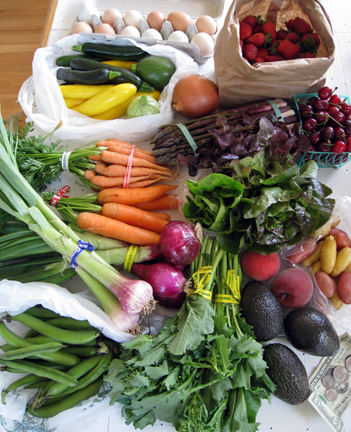
Here we have
ze famous Riverdog pastured eggs
ze famous Swanton strawberries
a yellow onion
cherries!!!
purple asparagus
assortment of the first summer squashes
little carrots & big carrots
ze lovely lettuces from Blue Heron
2 kinds of fingerlings (French & Russian, I think)
peaches!!!
avocadoes
broccoli raab
spring onions & fresh garlic
velvety, lovely fava beans
$5.70 (my no-fuss method of keeping track of how much I spend at the farmers’ market: I count in 20s & keep the change in my pocket)
When I saw the cherries, I thought I was gonna fall over in sheer surprise. When I saw the summer squash, I lost my mind. When I saw the peaches, my freezing little heart just melted.
Go forth & shop! The good stuff is all out there right now.